Monday, January 29, 2007
Catholic New World

The Chicago Archdiocese puts out a newspaper every other week, titled the Catholic New World. In between pleasant stories ("Candy Sales Provide Sweet Treats, Helps Ministry"), one of our great friends Dolores Madlener writes some eye-opening shorts on what is going on at local Churches: Here are some good ones showing the cultural Renaissance of Catholic Chicago
Symposium on Poulenc's Opera "Catholicism, Martyrdom and the French Revolution" Jan 28 at Depaul
Scott Turow Feb 2 at the Union League First Friday Club
Fr. Edward McKenna directs La Comica del Cielo music by Abbatini, libretto by Pope Clement IX at Our Lady of Pompeii on Feb 19th.
d'Vine Affair Wine Tasting Jan 28th at the Union Leauge sponsored by Catholic Charities
Catholic Physicians Guild Jan 27th at U of I Chicagao Newman Center
St. James Chess Club Tournament Results
Tridentine Mass in Highwood at St. James Parish 11:30 AM Third Thursdays
and the best news item of all...
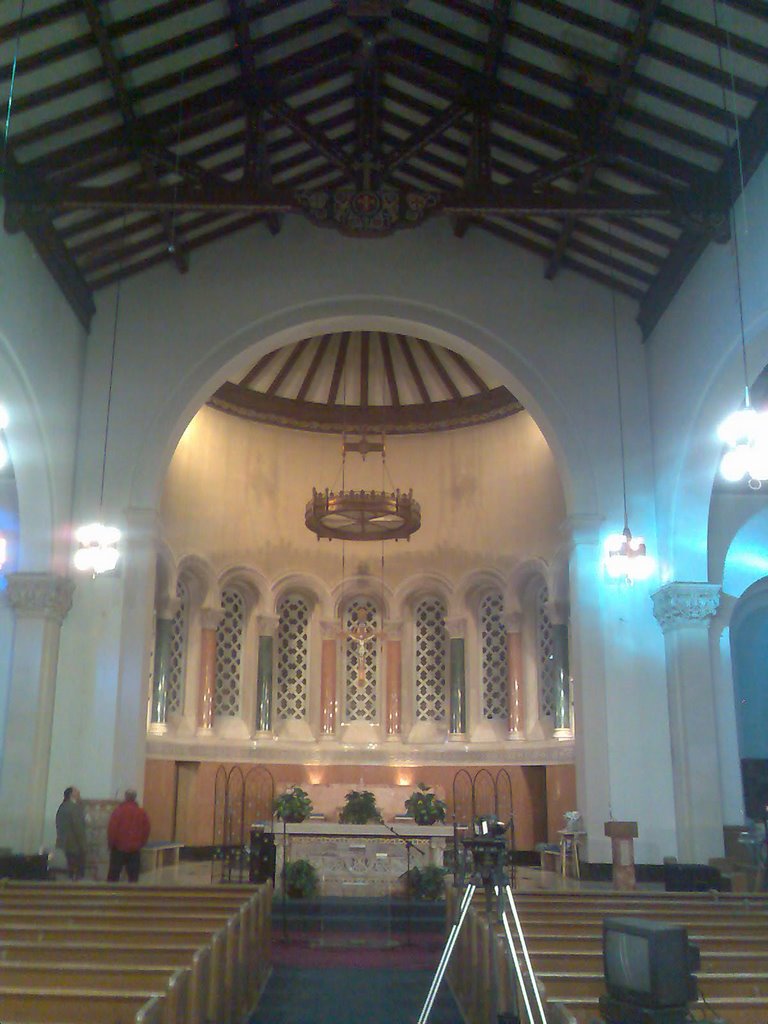
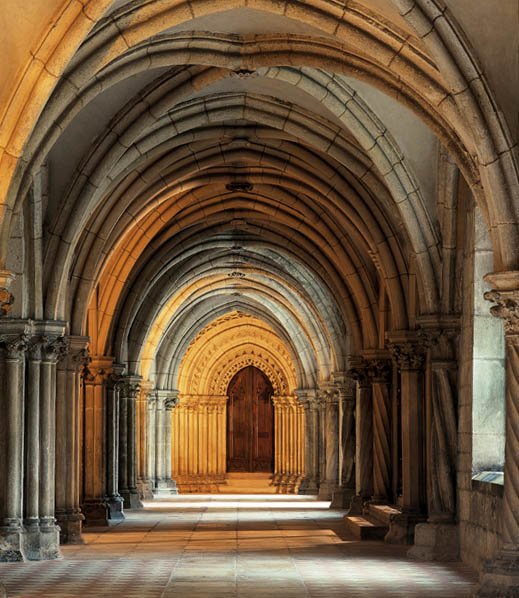
Basilica of Our Lady of Sorrows will be Open Daily from 8AM-4:30PM, Novenas at 8AM Friday
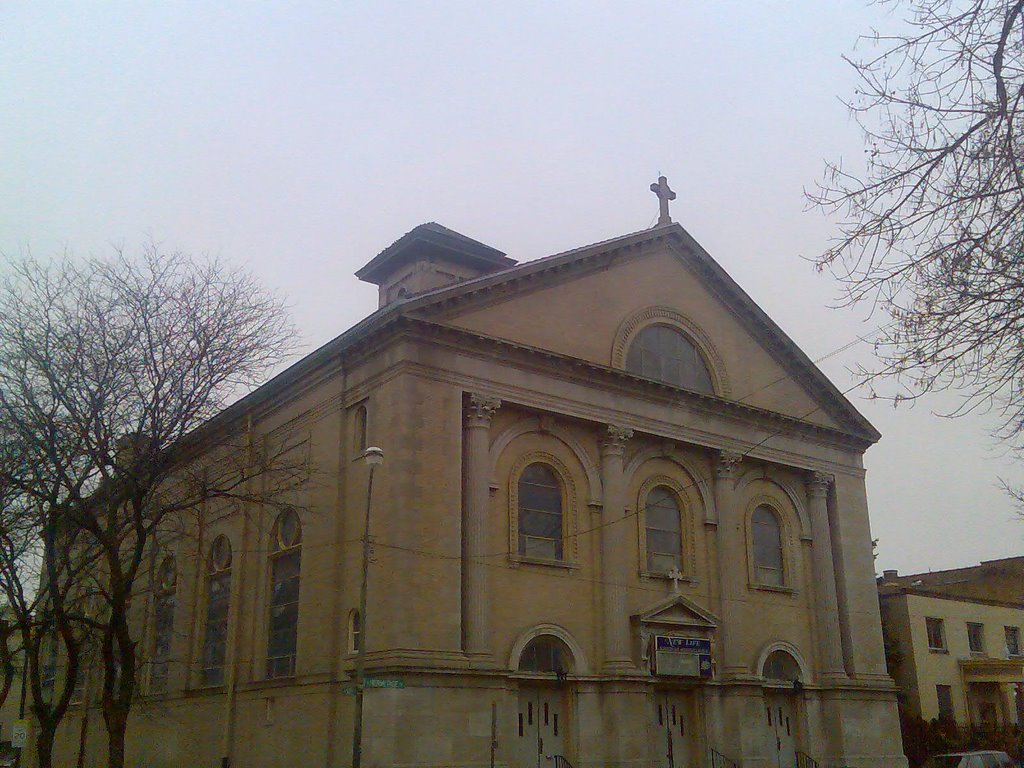
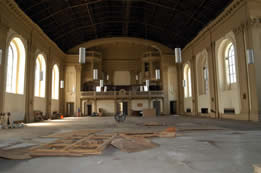
Three Cheers for the Servites and Father Frank Falco for opening up this Architectural Masterpiece! I celebrate with a previously unpublished James Morris photo. (Unpublished because I forgot to move the goofy looking fan, I suppose.)
Sunday, January 28, 2007
1st Round Draft Choice: The Archdiocese of New York
As I have mentioned, we are contemplating a publication of photographic history of the churches and chapels of Archdiocese of New York City. I have toured extensively in Manhattan and a bit in the Bronx, and have had numerous conversations with interested participants, but I think it would be fantastic to get some group interaction from the readers here. Here is a partial list
Old St. Pats
St. Malachy's
The original Manhattanvile College of the Sacred Heart (City College/Harlem) Is it still there? Eglise de Notre Dame 405 W. 114th
Catherine of Siena 411 E. 68th
Francis de Sales 135 E. 96th
St Francis Xavier 30 W. 16th St.
Jean Baptiste 184 E76th
St. Peters Barclay Street?
St. Thomas More 65 E. 89th
Fordham Chapel
Our Lady of Pompei 25 Carmine St.
Our Lady of the Rosary 7 State Street
St. Vincent de Paul 123 West 23rd St
St. Pats Cathedral
St Vincent Ferrer
St. Ignatius Loyola
St. Andrews (pictured btw)
So have at it...what 75 Churches and Chapels should be photographed for "Heavenly City: The Architectural Tradition of Catholic New York"....?
New Issue of SAJ in the Mail

Professor Stroik has done it again with fine episode of Sacred Architecture Journal. Book reviews and articles by Bill Heyer, (St. Barbara's scholar) Denis McNamara, Dino Marcantonio and many others in the current issue of the paper of record for traditional ecclesiology.
Here is a brilliant shot by James Morris, adapter for use in a SAJ publication
Read and Enjoy! Not a subscriber....SAJ will set you up
Saturday, January 13, 2007
From the Land of Sky Blue Waters

In an interview with The Catholic Spirit, one of the nation's top Ecclesioligists, Prof. Duncan Stroik tells it like it is:
"For a Catholic, and for a Catholic building, beauty is essential, because first of all, God’s middle name is Beauty. And he, being in his creation, created great works of beauty that we are able to be stewards of. So, in our own way, we’re asked to imitate the creator in also creating beauty. So that’s the most important reason that we should build beautiful buildings — that it’s for God, it’s for his glory and it’s an imitation of him."
The above photo shows Stroik's (soon to be declared) masterpiece, the Shrine to Our Lady of Guadalupe, in one of my favorite towns, LaCrosse, Wisconsin.
Labels:
Burke,
Guadalupe,
LaCrosse,
Notre Dame,
Stroik
More from St Vincent de Paul


Here are some shots of the fragile but beautiful St. Vincent de Paul in Manhattan from the Summer of 2006. And here is a prayer to St. Vincent that he may intercede on behalf of his built namesake, and permit another Light of Christ to reach this brilliant city.
Holy Mary, Mother of God, Pray for us.
Holy Mary, comforter of the afflicted, Pray for us.
Saint Vincent de Paul, Pray for us.
St. Vincent, who at the tenderest age didst display a wisdom most mature, Pray for us.
St. Vincent, who from thy childhood wast full of pity and compassion, Pray for us.
St. Vincent, who like David, from a simple shepherd becamest a ruler and pastor of the people of God, Pray for us.
St. Vincent, who in thy captivity by Turkish pirates didst preserve perfect freedom, Pray for us.
St. Vincent the just man, who didst live by faith, Pray for us.
St. Vincent, always supported on the firm anchor of a Christian hope, Pray for us.
St. Vincent, always inflamed with the fire of perfect charity, Pray for us.
St. Vincent, truly simple, upright, and fearing God, Pray for us.
St. Vincent, true disciple of Jesus Christ, always meek and humble of heart, Pray for us.
St. Vincent, perfectly mortified in heart and mind, Pray for us.
St. Vincent, ever animated with the spirit of Our Lord, Pray for us.
St. Vincent, generous maintainer of the glory of God, Pray for us.
St. Vincent, ever inwardly burning and ever outwardly transported with zeal for souls, Pray for us.
St. Vincent, who in Christian poverty didst find the precious pearl and the rich treasure of the Gospel, Pray for us.
St. Vincent, like to the Angels in thy purity, Pray for us.
St. Vincent, faithful in obedience and victorious in word and deed, Pray for us.
St. Vincent, who didst fly the slightest appearance of evil, Pray for us.
St. Vincent, who in all thine actions didst aspire to the practice of perfect virtue, Pray for us.
St. Vincent, who didst remain like a rock amidst the stormy sea of this world, Pray for us.
St. Vincent, invincible amidst the arrows of adversity, Pray for us.
St. Vincent, as patient in suffering as thou wast indulgent in forgiving, Pray for us.
St. Vincent, ever docile and obedient son of the Holy See, Pray for us.
St. Vincent, who hadst exceeding horror of the novel ways and subtle words of heretics, Pray for us.
St. Vincent, destined by a special Providence to announce the Gospel to the poor, Pray for us.
St. Vincent, father and model of ecclesiastics, Pray for us. St. Vincent, prudent founder of the Congregation of the Mission, Pray for us.
St. Vincent, wise institutor of the Congregation of the Sisters of Charity, Pray for us.
St. Vincent, tender in compassionating and prompt in relieving the necessities of the poor, Pray for us.
St. Vincent, equally fervent in the practice of prayer and in ministry of the word, Pray for us.
St. Vincent, admirable in imitation of the life and virtues of Jesus, Pray for us.
St. Vincent, who didst persevere to the end in shunning evil and doing good, Pray for us.
St. Vincent, who as in life so in death wast most precious in the sight of God, Pray for us.
St. Vincent, glory of France and pride of Paris, Pray for us.
St. Vincent, patron of all charitable associations, Pray for us.
Tuesday, January 02, 2007
Bagdhad by the lake

The Economist newsaper last year famously referred to Chicago as "Baghdad by the lake" noting:
A DICTATOR on the rampage; airfields destroyed; a pre-emptive strike; calls for outside intervention to bring democracy. It is not difficult to see why one cartoonist has lampooned Richard Daley's Chicago as “Baghdad by the lake”.
In my opinion Mayor Daley is no dictator, at least not a violent one. Yet, a creeping Statism pervades our Urban environment, presuming the Government is the best decision maker as to use of public resources. Consider this: the Cannes beachfront pictured above is most completely privately owned and managed. All manner of hotels, such as the Martinez (a haunt of PG Wodehouse among others) provide pretty much any service a visitor could want, right to your lounge chair on the Mediterranean. But if this privately owned model can work in semi-Socialist France, why not Chicago?
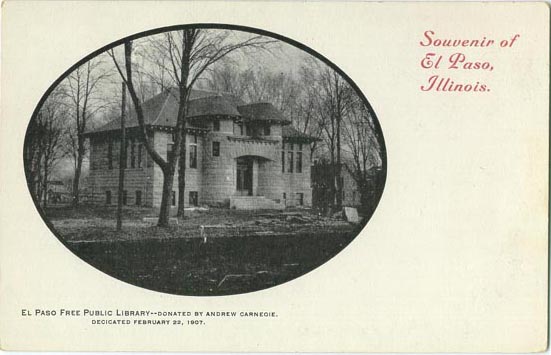
Well, back some 50 years ago, Chicago did have something quite like Le Croissette in Cannes: Edgewater Beach. Everyday luxury, a walkable neighborhood and yes, cold drinks served at your lounge chair on the beach.

So what happened? Well, you might notice that Lake Shore Drive is not in that postcard picture, as it was not built yet. Through an incessant demand for a quicker commute, landfill was inserted on the EAST side of the lake front to build the massive (and quite functional) highway. But in between, pedestrian and private access to Lake Michiagan were cut off. Anyone wanting to get to the Lake in this neighborhood is taking his life in his own hands.
So, since the loss of an Old Urban piece of brilliance is a lamented waste of natural resources one might think that the "progressive" elements in Chicago would work night and day to see that it does not happen again. Unfortunately, not true.
The long closed USX South Works in the South Shore neighborhood is a case in point. A 275 acre site surrounded by Lake Michigan is under redevelopment now, with many quite pleasant plans to implement "New Urbanism" non-vehicular everday life, with Metra Stops, restaurants, high density residential area, and most importantly: pedestrian access to Lake Michigan.
However, an alternate view exists, touting Government control of the lakefront in the South Shore neighborhood, cutting off human access to the Lake with another in a series of ill-advised, underutilized, poorly maintained, pedestrian-hostile "park". In a presentation titled "Completing the South Lakefront Parks:The Last Four Miles", a group claiming to be "Friends of the Park" are demanding control of "approximately 4 miles are not public parks but remain in private or quasi-governmental ownership."
Can anyone tell with, with the City's pathetic record on providing park access and maintenance, do we really want the city to appropriate the last area between Foster Ave and Indiana not under the Park District's thumb? Or would we rather have at least a French level of respect for private enterprise to provide human access to one of the finest natural resources in the Midwest?
Labels:
Chicago,
Friends of the Park,
South Works,
USX
Monday, December 25, 2006
Yearend Roundup 2

Following from below, (at least) 5 big positives occurred in 2006, which by no means should suggest that things couldn't be better in 2007. Here are 5 fun tasks for 2007.
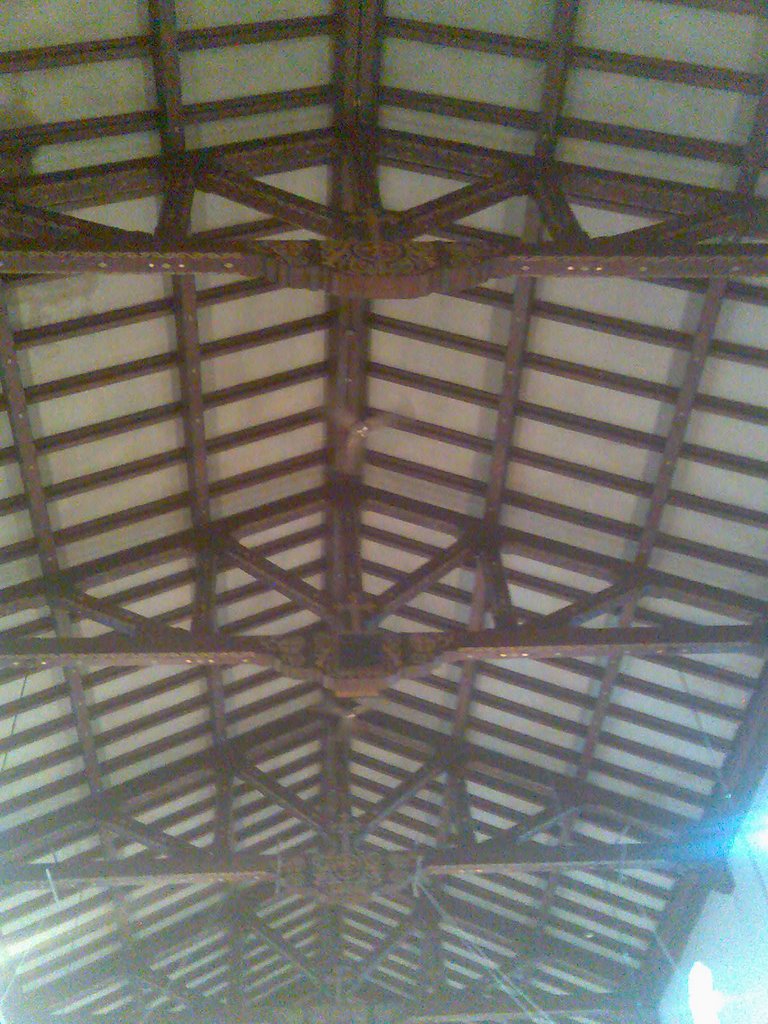
1) A section of the ceiling has fallen in at Marytown in Libertyville. Some of the great plasterwork in the Archdiocese is now in bits and pieces (but nicely arranged!) on the ground. Managable, worthy project, for those so inclined.
2) St. John of God and Sherman Park remain the most regrettable neighborhood in Chicago. A landscape masterpiece by Frederich Law Olmsted, and one of the great Schlacks churches of Chicago, lay wasting in this miserable neighborhood. I have a plan, if there are any takers...
3) The developments at Barat remain as hapless as one year ago, saving the decent Old Main building in a tortured tradeoff to destroy the Chapel, as masterpiece of Ecclesiology. Nearly 200 years after beating back the secularists in Revolutionary France, the Sisters of the Sacred Heart are having a whale of a time beating back the secularists of Lake Forest, Illinois. Here's a Christmas Whack to the vile developers, and an assurance of more to come next year. Fight the good fight!
4) Speaking of the Sacred Heart, Sacred Heart Academy is building a new Chapel in traditional Catholic Style. Checks anyone? It is a good one.
5) Ss. Cyril and Methodius in Chicago/Englewood has a very pleasant look about, and would make a perfect neighborhood anchor. Given the magnificent herd of Franciscan Friars I saw walking by it last week, one might want to get Herman Gaul's view of the Heavenly City.
Merry Christmas!
JBP
Friday, December 22, 2006
Yearend Roundup-2006

Everyone needs one of these, so if you missed it, here is some of went on in the Chicago area in traditional eclesiology.
1) James McCrery has been chosen to design the $8 Million Shrine to the Divine Mercy at St. Stansislaus Kostka, the mother Church of Polish Catholics in America. Round of applause to Mike Sullivan for answering prayers (and the telephone) leading this effort.
2) Church closings were minimal in the Archdiocese, but Quigley Preparatory Seminary will be closing in 2007. However, it will be kept in good condition and adaptively reused by the Archdiocese. Anyone want to restore the old library at Quigley? Send me a note and we'll do it.
3) Fr. Bob Lombardo, CFR put the flag in the ground for the Franciscans on the far West side at Our Lady of Angels Rectory. This is a Venetian Palace of a rectory (minus some of the frills, this is a Franciscan house!). Fr. Bob pulled off a minor miracle on this one, with help of his patron Saint, AJ Weinheimer and American Cleaning and Restoration
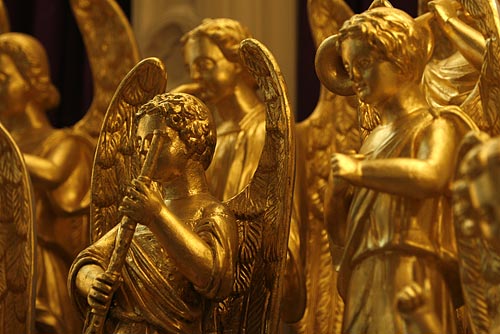
4) Fr. George Lane SJ continues to build the west side with a Historic 1879 G.F. Steinmeyer Organ being installed at Holy Family Church. Yes, this was once in the Danish National Cathedral, and yes Bach once tuned it, and yes, it sounds great on the West Side. Fr Lane also got these angels shined up.
5) The Insitute of Christ the King has won the Hyde Park neighborhood. How you say? When they moved in, empty lots were free for the taking. Only 2 years later the same lots are selling for $650,000 (too rich for me, but that is the going rate).
What an amazing way to build a neighborhood economy...take a bombed out church, say the Latin Mass, wear the traditional Robes, and Civilization has returned to the South Side, with a little help from Mt. Carmel High School and Tom Levergood at Lumen Christi.
Next up 5 Tasks
Tuesday, December 12, 2006
Englewood Church Tour (Part 1)


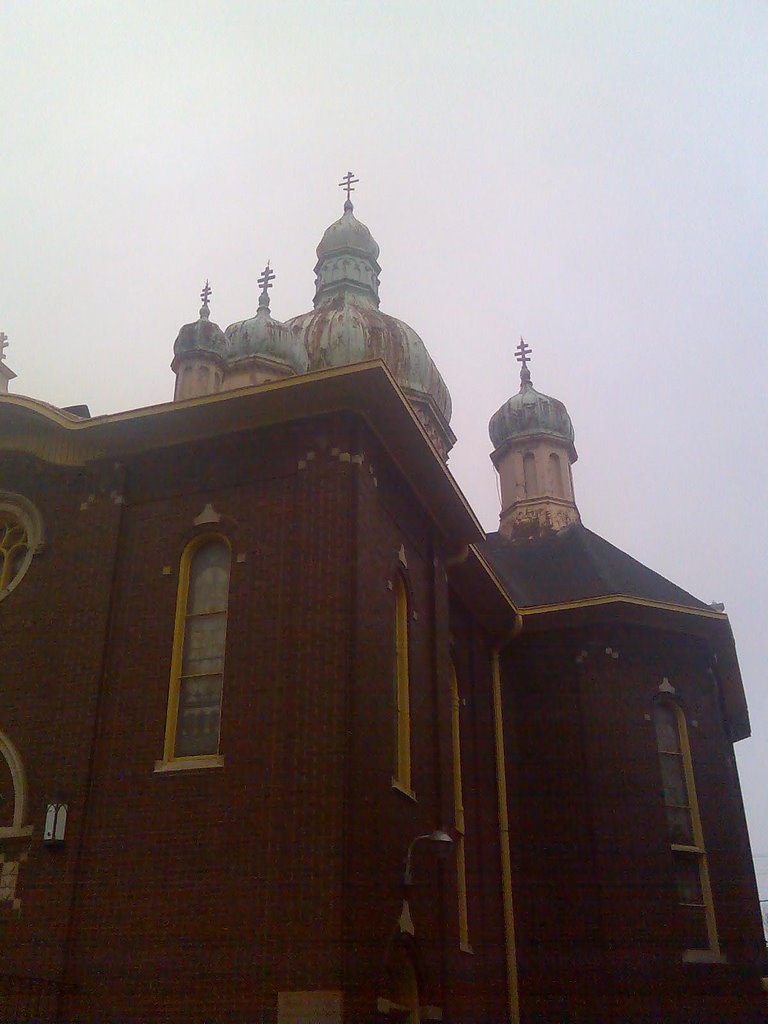
Yes, you may be taking your life in your own hands, but what better reason to take a risk than to see the lovely Churches of the Englewood neighborhood in Chicago. Englewood, near Sherman Park (and St. John of God), boasts 3 beautiful Churches I visited today. I will start with Nativity of the Blessed Virgin, a Ukranian Catholic Church at 4952 S Paulina St, (now the Apostolic House of Prayer). Onion Domes, Chicago Brick, seated squarely in the middle of Bungalow filled neighborhood; this is where the the Ukranians in Upton Sinclair Jungle worshipped, in a setting that does not seem Jungular at all.
Saturday, December 02, 2006
West Side Renaissance


Welcome back to the West Side of Chicago! The Mission of Our Lady of Angels (Grand and Pulaski) was dedicated today by his Eminence, Cardinal Francis George. The tireless Fr. Bob Lombardo, CFR (Grayfriar) pictured here with Cardinal George and VG Fr. John Canary, and a volunteer, has welcomed God's Providence to the Rectory, and was able to open the very nice adjoining church for todays visitors. The Rectory (not shown) is a splendid Venetian Palazzo, while the Church is very much in the style of Chicago Great, Joe McCarthy. Chalk one up for the good guys here!
Wednesday, November 29, 2006
TnT Architecture
Monday, November 27, 2006
Princess Gloria Thurn und Taxes and the South Side

The June 2006 issue of Vanity Fair Magazine mentions Princess Gloria and one of our local leaders:
"In 1991 she made her first visit to Lourdes, where she worked as a volunteer with the sick and dying who go there in hope of a miraculous cure. On a trip to Florence six years later, she became enthralled with Mons. Michael Schmitz, the vicar-general of the Institute of Christ the King Sovereign Priest, a conservative Catholic organization dedicated to restoring the Latin Mass. She also cultivated a friendship with the Bavarian-born Cardinal Josef Ratzinger, one of the most powerful figures in the Vatican."
Yes, that is Msgr Schmitz, the Vicar General of The Institute of Christ the King Sovereign Priest, heralding from the South Side at the old St. Gelasius Parish.
Good to see one of our own making the secular press in a very pleasant article about the restoration of Faith in one family.
Friday, November 24, 2006
It Can Be Done!
St. William, Austin, Texas: Before.

St. William, Austin, Texas: After.

More at The New Liturgical Movement.
St. William, Austin, Texas: After.
More at The New Liturgical Movement.
Tuesday, November 21, 2006
Scottish Rite Cathedral


Yes, we do shy away from Masonic Architecture at the SSB, but the reason involves minimal mischief, rather, the buildings are just locked up so tight that you cannot get inside. Chicago's Scottish Rite Cathedral, the beautriful Masonic Temple, formerly the Chicago Unity Temple was open today, thanks to our good friends at the Newberry Library.
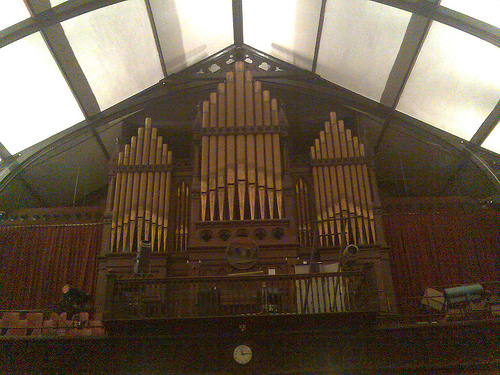
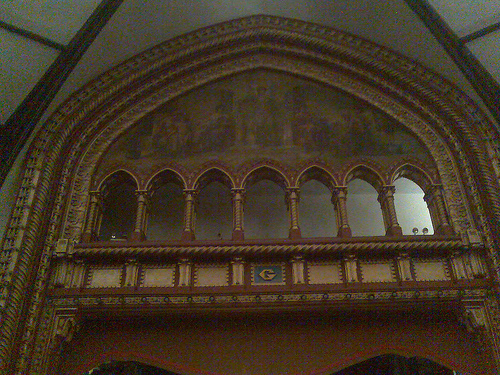
A Venetian Gothic landmark, with a madhouse of attached Mansions, subfloors, dressing rooms, this is a real must see in Chicago's Gold Coast. Yellow Joliet Limestone, similar to Holy Name and St. James Cathedrals, as well as the Water Tower, beautiful, primitive Arts and Crafts Stained Glass, and a magnificent organ all dazzle the visitor.
The stage/altarpiece is very Moroccan/Arts and Crafts Style, somewhat similar to St. Pascals, while the woodwork is quite similar to the fine Venetian carvings in the Chicago Athletic Association.
Anyone want to see more?
Wednesday, November 15, 2006
George Washington Smith and the Budget Church
I recently encountered the work of California revivalist George Washington Smith, who, despite having a name which sounds like a sixties novelty song performer, produced some intriguing if low-key work back at the beginning of the last century. Smith did not produce the most exciting work of the Spanish Colonial revival, and on the whole his work consists of those polite, plain-vanilla workmanlike background buildings that, in a more civilized age, would not require architects to get right. Still, his few ecclesiastical works show a more sophisticated touch within that simplicity, and offers much food for thought for those who would produce high architecture at a low cost.

Front Elevation: Immaculate Conception, Ajo, Arizona. A complex and beautiful detail--and one which would be fairly inexpensive to reproduce--enlivens and elevates an otherwise simple facade.
My favorite Smith work, and one of only two churches I am aware that he undertook, is the parish church he designed for Ajo, Arizona (the name means "garlic") as part of a masterplan for the would-be southwestern-style garden city. Immaculate Conception is intriguing, first, as it was designed as part of a new urban context, and not merely plopped into a suburban lot with only convenience as the determining factor. It faces onto the town's curvilinear main plaza, flanked on the opposite side of the road by a Protestant church originally intended to be of similar, if smaller and simpler, design.
This move--of differing denominations given equal time on a main square--is not an uncommon move in more recent attempts to plan an ideal city in a religiously mixed society; Lutyens did something similar with his plan for Hampstead Garden Suburb where the established Anglican church sends its spire upward next to the domed top of a Free Church meeting house. More recently, the folks at Seaside plopped a nondemoninational chapel down in their town more as a bit of urban furniture than an actual place of worship, and even then, as a civic gesture, the strange bit of preserved dune scrub later placed between the chapel and Seaside's Ruskin Square effectively negates any meaningful relationship between it and the town as a whole.
The church at Ajo has the happy advantage of being built in the southwest--like most of Smith's works--and thus is built in an adaptation of the local Hispano-Mexican vernacular. Stucco and adobe are capable of covering a multitude of budgetary sins, and also have the advantage of adding interest through their mottled surfaces to the vast unadorned walls that are often forced on the unmoneyed client. At the very least, with Catholicism raplidly expanding in the south and west, a careful study of such stucco and adobe work seems a very good idea for a church architect to undertake.

Merill & Pastor's recently completed elegant Carribbean Colonial-inspired Rosemary Beach Town Hall in Florida.
Recent secular work, such as that undertaken at Seaside and Rosemary Beach by firms such as Merrill Pastor show that not all modern stucco-work is of the supermarket strip-mall variety; such a wall-driven aesthetic allows money to be spent on refining and detailing to the highest level only very crucial symbolic and practical points in a church project. Smith is not the only architect within the last century to do decent simple work with the style--indeed, mixtures of low mission baroque and Romanesque revival crop up in an astonishing number of places and with a surprising quiet dignity. There's even a handsome mid-century brick-and-stone Romanesque church in chilly and distinctly un-Hispanic South Bend, Indiana, with a few generic Baroque flourishes that elevate it from commonplace to clever, especially considering the budget it was doubtlessly built on.
Indeed, Smith's other ecclesiastical project, a funeral memorial chapel-cum-vault, is in that mixed Romanesque-Baroque mode, with a simplified Baroque dome and a stripped-down Lombardic-inspired gable. It is a flexible style, and worthy of emulation for those having to count their pennies. Still, I'd caution architects to be careful with their revivalism--I can think of a good many bad Taco Bell-esque edifices inflicted on the Southwest, as well as even fairly good Spanish Colonial-style structures in places where they manifestly don't belong--wet South Florida, where a whole pueblo would wash away in one hour of summer rain, or even Minnesota, where vigas and bell-walls simply don't belong.

Holy Cross Parish, South Bend: Not a George Washington Smith project, but a somewhat later example of mixed Romanesque and Baroque elements, here adapted to a Midwestern contect.
Smith's church is more baroque than it is Romanesque, and it points to the curious fact that while America has always felt mildly uncomfortable around this most Italian and Catholic of styles, somehow in the southwest, its Spanish cousin seems to avoid setting off alarm bells for one of our nation's numerous stylistic neuroses. Perhaps the Franciscan connection is appropriately soothing. Whatever the reason, Smith's design is a brilliant example of how simplified Baroque detailing can enliven a remarkably plain, even stark, facade. Gothic suffers when reduced to basics, and full-blown pure Romanesque really requires real stone (and sometimes brick) to truly sing.

Immaculate Conception: the apse. Note the complex results achieved through the judicious combination of simple elements and the visual interest resulting from the distinct texture of the stucco. .
Immaculate Conception is a brilliant budget response to both the historical context of its site, and designed in such a way that its environment almost automatically brings out the best in it. Using a dome, rather than a campanile, to be the visual focus of the composition, is particularly clever, as it serves to dignify both the interior of the church and its exterior. A campanile has presence only on the exterior, and its purpose can be easily duplicated through a simple bellcote. The rough stucco enlivens potentially dull blank surfaces in a time-tested way seen across the whole of the Southwest--Georgia O'Keefe's painting of the oddly massive and unintentionally sculptural rear buttress of the Rancho de Taos parish church comes to mind--while its blinding whitness is all the more beautiful under an Arizona blue sky that lends itself to simple silhouettes. Still, while simplified, it is not merely simple, and its component parts not basic building blocks but cleverly massaged to pack the most into very little. While fairly cost-effective for its time, the design does not shy away from complex elements such as a dome or a conceptually elaborate--if simply rendered--broken pediment. A project such as this shows that baroque detail need neither impare the cost of a church, nor is it a style alien to the roots of American Catholic culture.

Immaculate Conception: Another view of the rear; note the bellcote to the left of the dome. On the whole, striking: though the dome's lantern might have been more interesting with true windows, rather than being blind as designed.
Simplicity does not mean plainness, or austerity. Nor does it is achieved by shying away from "fancy" details such as domes, cupolas, vaults or the elegant touch provided by a judicious bit of baroque detail. Such are the lessons taught by the church at Ajo, and they speak to the future of parish projects across both the Southwest, and in more abstract ways, the whole country.
Front Elevation: Immaculate Conception, Ajo, Arizona. A complex and beautiful detail--and one which would be fairly inexpensive to reproduce--enlivens and elevates an otherwise simple facade.
My favorite Smith work, and one of only two churches I am aware that he undertook, is the parish church he designed for Ajo, Arizona (the name means "garlic") as part of a masterplan for the would-be southwestern-style garden city. Immaculate Conception is intriguing, first, as it was designed as part of a new urban context, and not merely plopped into a suburban lot with only convenience as the determining factor. It faces onto the town's curvilinear main plaza, flanked on the opposite side of the road by a Protestant church originally intended to be of similar, if smaller and simpler, design.
This move--of differing denominations given equal time on a main square--is not an uncommon move in more recent attempts to plan an ideal city in a religiously mixed society; Lutyens did something similar with his plan for Hampstead Garden Suburb where the established Anglican church sends its spire upward next to the domed top of a Free Church meeting house. More recently, the folks at Seaside plopped a nondemoninational chapel down in their town more as a bit of urban furniture than an actual place of worship, and even then, as a civic gesture, the strange bit of preserved dune scrub later placed between the chapel and Seaside's Ruskin Square effectively negates any meaningful relationship between it and the town as a whole.
The church at Ajo has the happy advantage of being built in the southwest--like most of Smith's works--and thus is built in an adaptation of the local Hispano-Mexican vernacular. Stucco and adobe are capable of covering a multitude of budgetary sins, and also have the advantage of adding interest through their mottled surfaces to the vast unadorned walls that are often forced on the unmoneyed client. At the very least, with Catholicism raplidly expanding in the south and west, a careful study of such stucco and adobe work seems a very good idea for a church architect to undertake.
Merill & Pastor's recently completed elegant Carribbean Colonial-inspired Rosemary Beach Town Hall in Florida.
Recent secular work, such as that undertaken at Seaside and Rosemary Beach by firms such as Merrill Pastor show that not all modern stucco-work is of the supermarket strip-mall variety; such a wall-driven aesthetic allows money to be spent on refining and detailing to the highest level only very crucial symbolic and practical points in a church project. Smith is not the only architect within the last century to do decent simple work with the style--indeed, mixtures of low mission baroque and Romanesque revival crop up in an astonishing number of places and with a surprising quiet dignity. There's even a handsome mid-century brick-and-stone Romanesque church in chilly and distinctly un-Hispanic South Bend, Indiana, with a few generic Baroque flourishes that elevate it from commonplace to clever, especially considering the budget it was doubtlessly built on.
Indeed, Smith's other ecclesiastical project, a funeral memorial chapel-cum-vault, is in that mixed Romanesque-Baroque mode, with a simplified Baroque dome and a stripped-down Lombardic-inspired gable. It is a flexible style, and worthy of emulation for those having to count their pennies. Still, I'd caution architects to be careful with their revivalism--I can think of a good many bad Taco Bell-esque edifices inflicted on the Southwest, as well as even fairly good Spanish Colonial-style structures in places where they manifestly don't belong--wet South Florida, where a whole pueblo would wash away in one hour of summer rain, or even Minnesota, where vigas and bell-walls simply don't belong.
Holy Cross Parish, South Bend: Not a George Washington Smith project, but a somewhat later example of mixed Romanesque and Baroque elements, here adapted to a Midwestern contect.
Smith's church is more baroque than it is Romanesque, and it points to the curious fact that while America has always felt mildly uncomfortable around this most Italian and Catholic of styles, somehow in the southwest, its Spanish cousin seems to avoid setting off alarm bells for one of our nation's numerous stylistic neuroses. Perhaps the Franciscan connection is appropriately soothing. Whatever the reason, Smith's design is a brilliant example of how simplified Baroque detailing can enliven a remarkably plain, even stark, facade. Gothic suffers when reduced to basics, and full-blown pure Romanesque really requires real stone (and sometimes brick) to truly sing.
Immaculate Conception: the apse. Note the complex results achieved through the judicious combination of simple elements and the visual interest resulting from the distinct texture of the stucco. .
Immaculate Conception is a brilliant budget response to both the historical context of its site, and designed in such a way that its environment almost automatically brings out the best in it. Using a dome, rather than a campanile, to be the visual focus of the composition, is particularly clever, as it serves to dignify both the interior of the church and its exterior. A campanile has presence only on the exterior, and its purpose can be easily duplicated through a simple bellcote. The rough stucco enlivens potentially dull blank surfaces in a time-tested way seen across the whole of the Southwest--Georgia O'Keefe's painting of the oddly massive and unintentionally sculptural rear buttress of the Rancho de Taos parish church comes to mind--while its blinding whitness is all the more beautiful under an Arizona blue sky that lends itself to simple silhouettes. Still, while simplified, it is not merely simple, and its component parts not basic building blocks but cleverly massaged to pack the most into very little. While fairly cost-effective for its time, the design does not shy away from complex elements such as a dome or a conceptually elaborate--if simply rendered--broken pediment. A project such as this shows that baroque detail need neither impare the cost of a church, nor is it a style alien to the roots of American Catholic culture.
Immaculate Conception: Another view of the rear; note the bellcote to the left of the dome. On the whole, striking: though the dome's lantern might have been more interesting with true windows, rather than being blind as designed.
Simplicity does not mean plainness, or austerity. Nor does it is achieved by shying away from "fancy" details such as domes, cupolas, vaults or the elegant touch provided by a judicious bit of baroque detail. Such are the lessons taught by the church at Ajo, and they speak to the future of parish projects across both the Southwest, and in more abstract ways, the whole country.
Tuesday, November 07, 2006
Evangelizing Through Beauty

The renowned speaker and evangelist Fr. Robert Barron will be giving a lecture titled "Evangelizing Through Beauty" on Monday, December 4 at the Union League Club in Chicago. Fr. Barron, of fame for the Word on Fire series on EWTN, is a Chicago native tasked with evangelizing in the Archdiocese. Here are 4 good reasons to attend the lecture
1) World renowned speaker and scholar talking about a subject critical to the mission of the Society of St. Barbara
2) Free lunch, courtesy of the Archdiocese (don't worry, you will get hit up for a donation later)
3) Meet likeminded souls, searching for the truth during their lunch hour
4) Marvel at the surroundings of the architecturally stunning Union League Club of Chicago, pictured in this entry.
Please contact John Powers if you can attend. Room is strictly limited to 200, so RSVP is necessary.
Tuesday, October 24, 2006
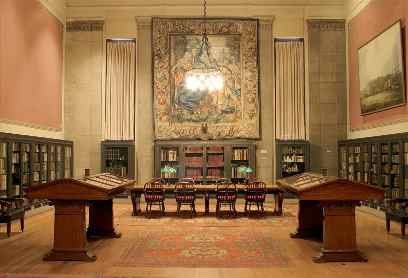
More Great Libraries
Great Libraries of the World

Looking for the perfect Christmas present?
Look no further than our corresponding organization in Sweden, the Renaissance Library, publishers of the Renaissance Library Calendar.
We have worked closely with Stuart Irwin at The Renaissance Library Collection to produce this year's calendar...as this year a Chicago gem is featured, the Archdiocese of Chicago, and Mundelein Seminary that is..the Feehan Memorial Library is the November library of the month. Tens of Thousands of photos of the Feehan Library will be distributed and recognized as on of the great libraries of the Architectural Renaissance (albeit, this restoration being from the 1920's). Order as many as you like at $12.95+ $3.05 = $16.00 including UPS Ground freight. All proceeds go to the Bricks and Mortar Foundation.
Sunday, October 22, 2006
New Shrine Coming to Chicago?
Good Show on the South Side

Picture this...50 people crowded into a rectory basement, hanging on every word of a dedicated young Notre Dame architect from Columbus Ohio, talking about the crowning achievement of a dedicated architect from Notre Dame, albeit 80 years ago. To top it off, the crowning achievement is up the stairwell, and across the garden, an architectural masterpiece waiting to be restored. Henry Schlacks is making a comeback in Hyde Park.
Who was there?
The Clergy from the Institute of Christ the King; several highly energized young architects/architectural students/Holy Whapping from Notre Dame; the undeniable Joe McHale-the grandson of an architect even more prolific than Schlacks-Joe McCarthy; a group of traditional minded Catholics from Wayne, Illinois who had met a ICK priest in France and wanted to see what is going on; about 20 parishoners who attend the Latin Mass at the Rectory basement; a smattering of architectural buffs a few locals from the neighborhood, and a carload from the north suburbs who just came for the food (including a cake from Oscar-from St. Stan's and the Shrine of the Divine Mercy)
How can you help?
A great recommendation from Msgr Schmitz is to pray the Chaplet of the Divine Mercy at 3pm each day to seek intercession from Our Lady.
How can Our Lady Help?
One of my favorite parts of the litany is the Help of Christians, of which Our Lady is certainly up to task. Perhaps her intercession may induce you to:
1) Attend Mass at the
Shrine of Christ the King
6415 South Woodlawn Avenue
Chicago, Illinois 60637-3817
2) Volunteer your time and labor to restoring this marvel
3) Send a check to Cristina Borges at Christ the King, formerly of EWTN, now leading fund raising at ICK
4) Spread the word. Contact Crisitna for more details cborges@institute-christ-king.org
Subscribe to:
Posts (Atom)