Saturday, April 29, 2006

Interview with Panos Fiorentinos


Here is a pleasant interview with our great friend Panos Fiorentinos that aired on WBEZ's program 8:48.

Panos is the author, photographer, and producer of the the Greek Church Book, Ecclesia, which is the #1 gift given by the Society of St. Barbara. Icons! Colors! Urban Churches! The Chicago Metropolitan has a testament to the Liturgy in Color in Ecclesia.

Wednesday, April 26, 2006

Chicago Churches Tour


The lovely city of Chicago wll again host the Great Chicago Places and Spaces tour this year May 19-21. Our friend Suzanne Morgan wil lead

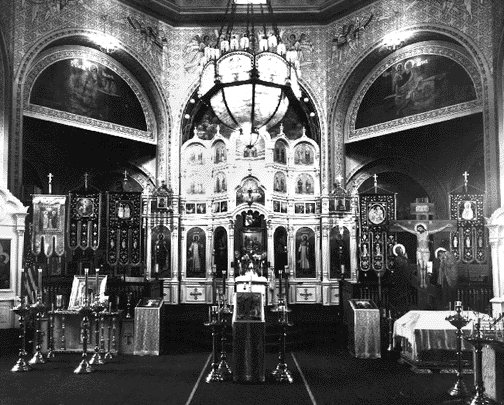
"Icons & Crosses: The Christian Orthodox Church (trolley, 32) Suzanne Morgan, Chicago Center for Religious Architecture Rich in symbols and ritual, candles and icons, this tour will emphasize the unique features of architecture and worship. This tour will feature Annunciation Greek Orthodox Cathedral, Christ the Savior Orthodox Church and Holy Trinity Orthodox Cathedral"

Yes, that is Louis Sullivan's Cathedral, and yes it is still standing while Pilgrim Baptist tragically burned down.

Then why not try

"Three Sacred Spaces (bus, 52) Ward Miller, Project Architect and Richard Seidel, Historiographer, Diocese Chicago Experience Louis Sullivan's Holy Trinity Orthodox Cathedral, St. James Cathedral, The Cathedral of the Prairie and Holy Family Church. Bring your own lunch and comfortable shoes!"

The doors will be open. Please donate generously to the Church of your choice while you visit, and enjoy a Sacred Chicago.

Wednesday, April 19, 2006

Czech and Slovak Chicago


After attending lunch presentation by Secretary of State Rice today, my mind drifted to the fine ventilation system, hidden in the plasterwork at the Conrad Hilton Grand Ballroom on South Michigan Avenue. Very well done, contemperary and integrated into the beauty of this great room.

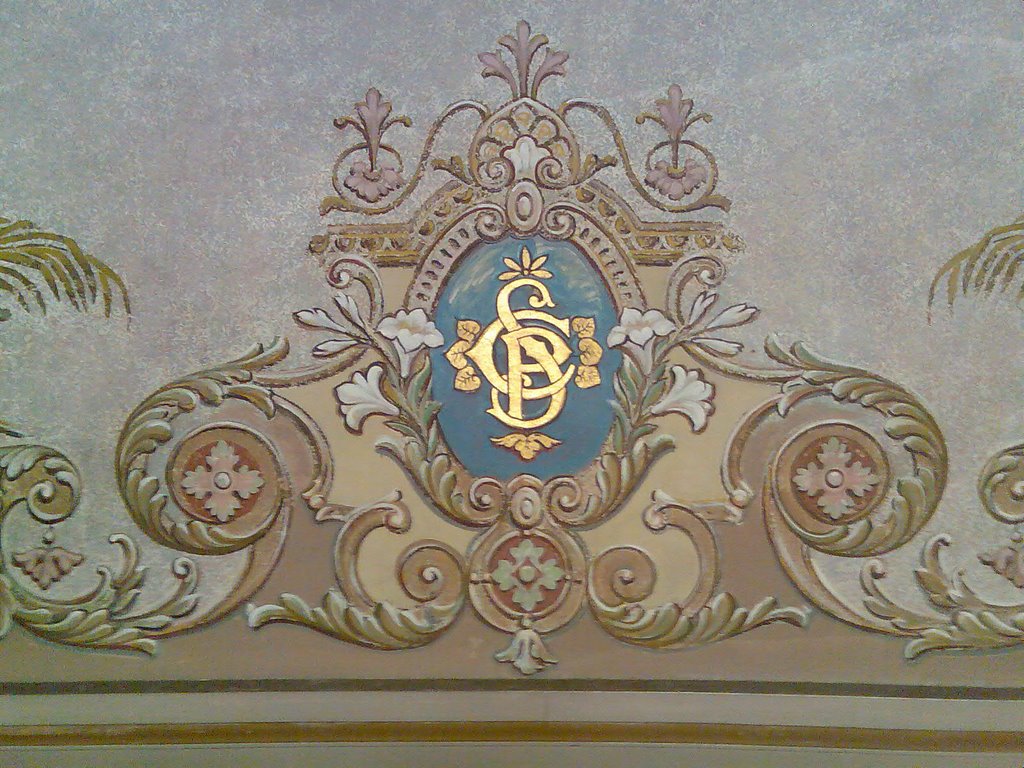
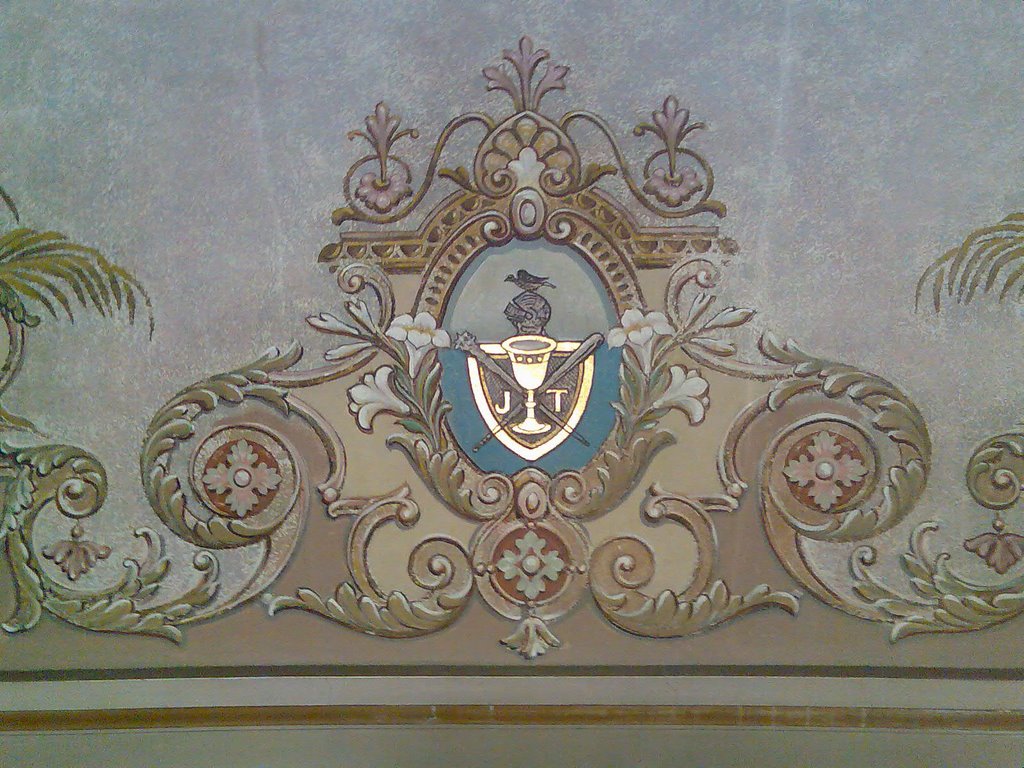
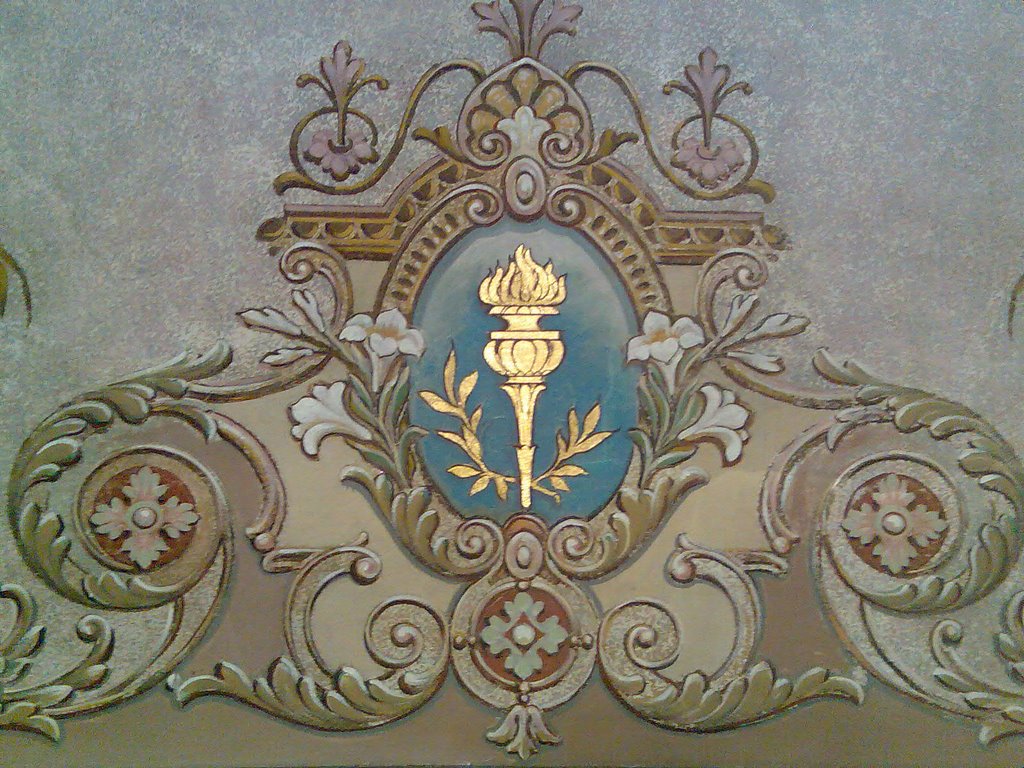
Which reminded me, John Mallin painted some fantastic murals in Chicago Churches, but also could make a mean medallian. On invitation from the Friends of Bohemian National Cemetery, I stopped at a hidden gem on Pulaski and Foster in a broad Cemetery. The Crematorium interior is a must to behold. Here are the medallians. Click on each for more detail.


Wednesday, April 12, 2006

Visitation: An OPEN Church on Holy Thursday

Tomorrow is Holy Thursday. The Churches represented on the accompanying Google Map are welcoming visitors, prayers, and pilgrims. Click on the Title to drill down (get more detail) on the Map. This Map is not quite ready for publication, but it is fairly accurate. Please check below for specifics, and drop something in the collection box.

St. Mary of the Angels-open all day Evening Mass of the Lord’s Supper 7:15 p.m. Visitation and Adoration of the Holy EucharistUntil 12:00 midnight

St. John Cantius-open all day. 8AM Office of Tenebrae 7PM Misas Brevis. Confession till 9pm. Visitation and Adoration till Midnight.

Holy Trinity Open 10AM-Noon for confession and Adoration. 7:30pm Mass. Visitation Adoration until 10PM

St. Stanislaus Kostka Church open 6pm. Rosary at Church 6:30PM 7PM Mass. Visitation and Adoration till 11pm

St. Hedwig-open from 7pm (Mass) to 10:30pm for Visitation and Adoration.

St. Josaphat Morning prayer 9am Mass 7:30PM Adoration until 12Midnight.

Monday, April 10, 2006

Holy Week in Chicago


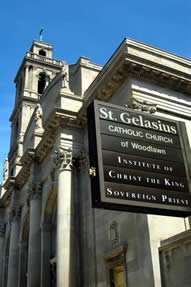
The Institute of Christ the King has announced Holy Week Services in Chicago for the first time at St. Gelasius. St. Gelasius, the first project of the Bricks and Mortar Foundation, has been a great success story, with Msgr Michael Schmitz developing a strong Mission on the South Side of Chicago, near the University of Chicago. Please join the Institute for Holy Week.


Palm Sunday 9:30 am
Holy Thursday 6:30 pm
Good Friday 3:00 pm
Holy Saturday/Easter Vigil 9:00 pm
Easter Sunday 9:30 am


Contact the Institute of Christ of King:
The address is as follows: 6415 South Woodlawn Avenue Chicago, IL 60637
phone: 773 363 7409 fax: 773 363 7824

Monday, April 03, 2006

In Chicago style, vote early and often


"Heavenly City", Denis McNamara and James Morris architectural history of the Archdiocese of Chicago published by Liturgy Training Press, has been nominated for a Benjamin Franklin Award. This prestigious award is presented by the Independent Book Publishers Organization is a great honor, and the entire crew behind Heavenly City is grateful to be considered for such a fine deal.

Two cheers for Denis and James. The third one comes if they actually win.

Saturday, April 01, 2006

Trackback to Lick Observatory and more Quiz


Thanks to Marcus Scotus, we now have two observatories profiled. Yerkes in Lake Geneva, Wisconsin, and Lick Observatory in California. Though history has not been kind to him, Mr. Yerkes developed the Chicago El and the London Underground Railroads.

Quiz two,

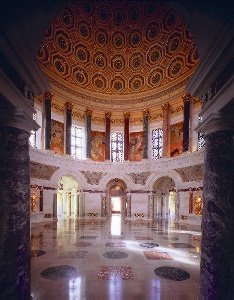
Identify the above Chicago Classical Structure. This is an interior shot in of the structure in Lincoln Park.

Thursday, March 30, 2006

Classical Architecture Quiz


Came across this photo looking for information on the Chicago El. For 2 points and digital photo of your favorite Chicago Church, indentify this photo.

Clues
1) If it sort of looks like a Church, well... Many Cathedrals were used for the same function as this facility.

2) The building is closely associated with, but not located in Chicago.

3) The buiding is named after a major builder in Chicago and London.

Get your 2 points!

Tuesday, March 28, 2006

Concerts at St. James Chapel


Announcing 2pm Second Saturday concerts for St. James Chapel at Quigley Prepartory Seminary on Rush at Pearson in Chicago.

April 8th A Trio
Michael Gurt-Piano
J. Patrick Rafferty-Violin
Paul York-Cello

The total experience with classical music within the jewel of a Chapel is sublime.

Please attend and enjoy the show!

Thursday, March 23, 2006

Traditional Building Trade Show in Chicago


The Traditional Building Trade Show will be held in Chicago on April 5-8 at Navy Pier's Festival Hall A. What better way to shake out the Winter and welcome the Spring than a festival full of Stained Glass, Limestone, and Wood Carving?

Tickets are available here. They should be free.


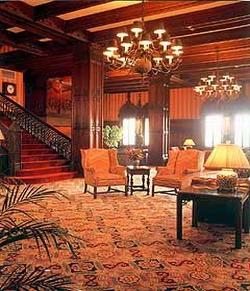
Seminars etc will cost money, but the show floor is generally FOC. If you have the nerve, the organizers recommend staying at the Congress Hotel. Duck your head into the Gold Room, pictured here, one of the most beautiful rooms in the world, and very underutilized. Shall the Society of St. Barbara hold its annual dinner here?

Thursday, March 16, 2006

More Catholic Scientists (or The Missing Barber of Berkely)


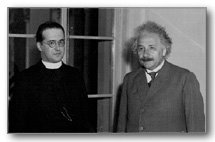
Stumbled on this today from Ignatius Press; Georges Lemaitre (1894-1966), a Belgian mathematician and Catholic Priest was a pioneer in developing the Big Bang theory of the creation of the universe.

During a series of lectures at Cal-Berkely in 1933, Fr. Lemaitre introduced the world to his revolutionary theory. After the Priest detailed his Big Bang theory, Einstein stood up applauded, and said, “This is the most beautiful and satisfactory explanation of creation to which I have ever listened.”

I dedicate a photo of the Belgian (Flemish/French) Roman Catholic Church in Chicago, St. John Berchams to the innovation and deciation of Fr. Lemaitre.

Saturday, March 11, 2006

Help Identify this Liturgical Element


Within St. John of God on Sherman Park there is this unique fixture above the Mary Altar, with a Polish Inscription. Can anyone identify the piece? The artist? Translate the inscription to English? This is a very splendid piece of adornment, hanging in this shuttered church. Anyone have a current need for it? I will contact the Archdiocese if you need it.

Click on photo for more detail.

Thursday, March 09, 2006

Where in the world is SJOG?


A Grand Basilica on a late winter's day in Normandy? Relaxing lagoon, charming fieldhouse, and the majesty of the twin towers of a Baroque masterpiece on the north edge of a picturesque park.

Welcome to the South Side of Chicago! This is St. John of God in Sherman Park. I spent the day catalogging the art and architectural furnishings of SJOG, and will post these soon. (Click on the photo for larger image)

The church is currently vacant, a bit damp, and an architectural masterpiece by HJ Schlacks.

Wednesday, March 08, 2006

The End (Cap) Times are Here


Who would have thunk it? (Is that from Dizzy Dean?)

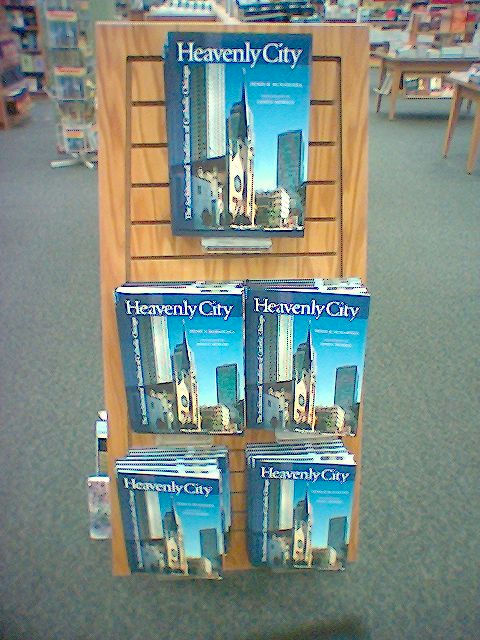
So, if you had a maniacal scheme to take a series of photographs and write an architectural history of the Archdiocese of Chicago, would you think it would come out on an endcap at the Borders Bookstore down the street from your house. Pictured here is a terrific stack of soon to be depleted Heavenly City books, at the Borders Wilmette store. Someone must like these things, as they are turning up everywhere.

Monday, March 06, 2006

Give me three good Episcopalians, and keep the doors unlocked


St. Thomas
St. Mary the Virgin
Grace Church

They are all three beautiful. More importantly, they were all unlocked when I went to see them this past weekend.

Fr. Joseph Fessio, S.J at the CAA


The renowned Catholic leader Fr. Fessio, SJ will be the monthly luncheon speaker at Catholic Citizens this Friday (at the architectural gem) Chicago Athletic Association. The food is good, the dining companions generally combative, and the speakers in this series have been terrific. The Catholic Citizens are led by the fearless Tom Roeser.

If you get the chance, take a look at the Venetian stonework on the windows facing the Lake Michigan seawall. Sure to be a winner.

Saturday, March 04, 2006

Blue Sky, Golden Stars in Peoria


Some good friends of mine and I took a trip last week down to Peoria under the sad circumstance of attending a funeral at a local parish. On the way back, after praying for the deceased and spending a few quiet moments with the family, we took the opportunity to visit the cathedral. We'd seen it on the way in, its tall American Gothic spires rising against the forested slopes of the river valley. It was one of those warm-chill days that crop up occasionally in the borderlands of an Illinois spring, the honey-gold stone of the church vivid against the bright, flat blue of the sky. One of our number had been there before and found it locked that time, and after we'd parked the car, we'd found it still was.

So we decided to go ask the bishop to let us in.

This isn't too far-fetched. I won't go and say that we're tight with the Most Rev. Daniel Jenky, but the man does have deep connections to Notre Dame. During his stint as rector of ND's Basilica of the Sacred Heart, the gilt went back on the floriated gothic column capitals, the ambo got cranked up a couple of few, and the Stations of the Cross ended back up on the walls after a long and dusty search through a dozen campus attics and store-rooms.

Buzzing at the cathedral rectory next door, we found out that his Excellency was out but they'd certainly let us have a look round the place.

Even a cursory glance at the outside is pretty memorable. It's one of the more monumental examples of 19th century American Gothic, in particular the vernacular, charmingly quirky take on it that one finds sprinkled through the rolling hills of the Midwest. Twin high-steepled octagonal spires loom over the low-lying town all around it, twin gilt crosses high in the sky overhead. The stonework is rough, not quite irregular, but rustic and rugged enough to suit the town's bucolic surroundings, and reminiscent of Pugin's dictum that small stone blocks made for more interesting walls than plain ashlar work. The doors are an episcopal purple--slightly jarring at first, but not without interest--with burly verdigrissed hinges that look as old as the hills. In terms of massing and decoration, it tends towards simplicity of line and shape, as befits its place and period, but keeps the monumentality necessary even in a fairly small cathedral.

Inside, his Excellency has done a fine job bringing the place back to life. The Cathedral has gone through numerous face-lifts in the past century. At one point, the paint job had tended towards the darkness and mystery recommended by Cram and his compatriots, while more recently, much of the gilding and woodwork was lost under a bland coat of whitewash. Over the course of a couple of interventions, the chancel stalls were taken out, the altar-rail dismantled and turned into fodder for a smallish ambo, and an incongruous '80s-style tabernacle installed in one of the side-altars. Jenky put a stop to all that. One of his first moves upon being elevated to the see of Peoria was to move Christ back to where He'd always been before, at the center of the reredos.

A lot had been lost, and re-shuffled in the meantime, and the Bishop had to make the best with what he'd been given. He has. The elegant Gothic reredos, all gilt and creamy-white apparently had been partially patched together from an astonishingly ornate canopy that had once stood over the episcopal cathedra on one side of the chancel, for instance. At the center of the reredos is a copy of Velazquez's famous Crucifixion, which at present does not quite fit within the framework of the altarpiece but nonetheless serves as one of the few remaining links with the original cathedral.

A few other additions came in the form of re-using old side-altars as shrines that flank the chancel and are marked off by the partial reinstallment of the old altar rail. One now serves as a baptistery, the other as a shrine to Our Lady of Guadalupe. The church is lofty and luminous, white walls setting off a remarkable acreage of indigo stained glass peopled with saints and martyrs, missionaries and sacred heraldry. The place has a pleasant airiness that still retains some of its mystery. In terms of plan, it is almost a hallenkirche, a familiar Teutonic design with aisles almost as high as the central nave. Granite pillars of astonishing height and slimness soar up to a elaborately-ribbed vault, now painted blue and white, and perhaps, we were told, in the near future that blue sky may be emblazoned with medieval stars as is the bishop's wish.

Most impressive, though, is the renovation of a small space off the chancel, a former winter chapel, as the church's relic chapel. It is dark and holy, with vivid stained glass of the martyrs John Fisher in full pontificals, Thomas More and Oliver Plunket in purple and scarlet, looking almost dashing in a Charles II goatee and mustache. Jenky was perhaps inspired by the old relic chapel at Notre Dame--the current form of which was probably his idea to begin with--and has brought it to his new home here. A relic of the true cross holds pride of place behind the altar, with glass-fronted cabinets on either hand. We pressed our fingers to the glass and counted off each one, excited and delighted as we recognized the names of old dear saintly friends--Aquinas, Albertus, Matthew, Maria Goretti and more. Overhead, the stars already shine in the blue-vaulted sky, the work of Murals by Jericho, a company which has also tricked out Peoria's parish of St. Mark in a remarkable set of reproductions of the work of Fra Angelico.

The relic chapel also features a surprisingly baroque chair belonging to canonization candidate Fulton Sheen, whose cause the Bishop is spearheading. Some day, come his beatification, his body may rest here, or perhaps at the first parish he served at, just a few blocks away. It was sold to a Protestant demonination some years back, but the interior, altar and all, remain untouched. While perhaps it is wishful thinking at present, one can't help wonder what a fine national shrine that church might make should it ever be re-patriated.

There is much else to recommend this little-known vernacular gem. A small shrine to St. Therese of Liseux features gold-dipped roses given by a priest as ex-votos for every vocation he has prayed for that has come to fruition (and in recent years, he's donated quite a few), while the cathedral has two organs, a small chamber piece down on the floor and one high up in the uppermost of the church's two lofts. Occasionally, they play the two of them at once, ad alternim in the fashion of the great churches of the Renaissance.

While we miss Bishop Jenky down at ND, seeing what he's done with his time here, we can't help thinking he's done a whole lot with only a little time. Given rumors we heard mention of future frescoing--not just gold stars--we hope that his embellishment of the cathedral church of his diocese will continue well into the future, and set a standard of artistic and spiritual excellence for all those who will sit in the cathedra after his tenure.

Saturday, February 25, 2006

Restoration 2-Welcome to Chicago, Illinois


Cardinal Henry Stuart-Duke of York (a job now held by Prince Andrew), died in 1807 , some 15 years after the failed Irish Revolution of 1792 and 25 years after the successful American Revolution (no word on the Henry Stuarts feelings on the rebellions). Via the failed Irish Revolutions, punitive laws prohibitting Catholic Landowning in Ireland, millions of Irish take to the new countries of the United States and Australia (among many others), some ending up on Adams and Halsted in Chicago, at the then new Old St. Patricks in 1846.

As Ireland's own Catholic Churches had been disassembled or destroyed by the occupying British Armies, architects, such as Augustus Bauer and Asher Carter of St. Patricks, drew on the Roman Architectural tradition to develop Chicago's Irish parishes. Holy Family on Roosevelt and May was designed in the same period with even greater grandeur and European heritage. Central and Western Illinois were (and still are) populated with numerous St. Patrick's as champion of the Irish immigrants seeking wages, land ownership, and additional religious freedoms.

The buildings themselves had very little Irish heritage to draw upon, leaving the church designs to flow from the general Roman Catholic church building tradition. The Restoration of the Church began in earnest as an inspired vision to connect to the broad sweep of Catholicism.

How the Restoration Started (Part 1)


Pictured above is Henry IX, Cardinal Duke of York, great-grandson of Charles I, and the one-time owner of the English Crown Jewels. While Charles II, Henry's great-uncle, was restored to the crown of England, after the Cromewellian revolution, Henry was never crowned King of England. Englands loss though, was a great gain for the Roman Catholic Church, with Henry IX leaving a great legacy of building in Italy highighting the finest in Art and Architecture, brining generations of English Speaking Catholics into communion with Rome.

Thursday, February 23, 2006

Whiting Indiana, Whiting Indiana, Whiting Indiana


Pardon the Music Man, but driving back from Notre Dame this morning, the industrial landscape is widely regarded as bleak and doomed, thus all the better for the beacon of Heaven's incarnation on Earth to show as brilliantly as St. John the Baptist in Whiting Indiana. Big, brawny, Polish, and a Herman Gaul masterpiece, I stopped for a tour and visit. Sparkling interior, typical of the best Polish Churches, and as well built as her sisters in Chicago, St. John the Baptist, and the beautiful Parish School next door, find a dramatic context in Northwest Indiana.